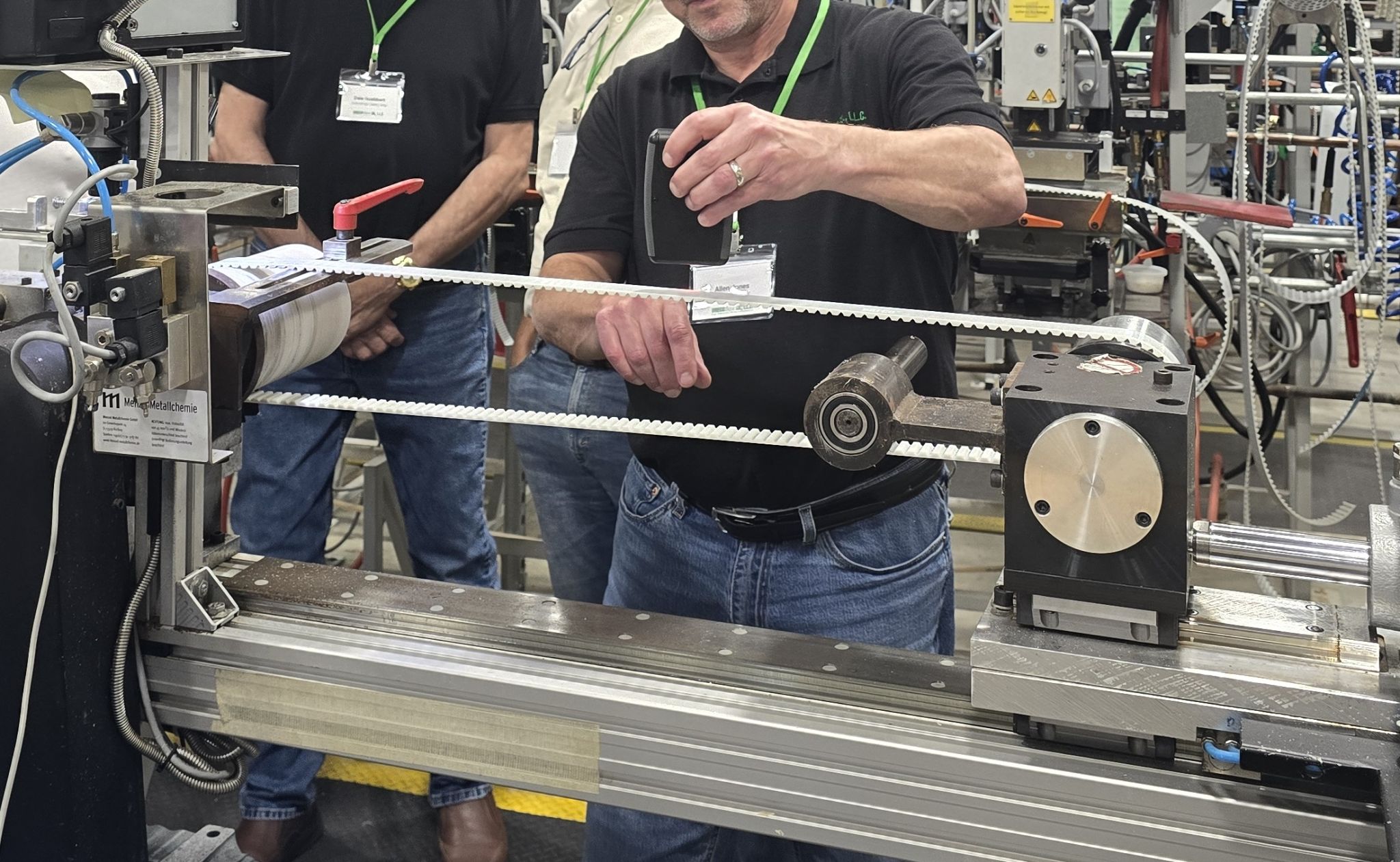
Chain drives are used as a reliable, heavy-duty option for conveying, linear motion, and power transmission. But all that strength comes at a cost: more maintenance, lower efficiency, and higher long-term operating expenses.
For some applications, the strength of chains is necessary, but for others timing belts can be an effective alternative. Polyurethane timing belts offer a wide variety of benefits like low-noise and minimal service, especially in systems that require highly precise motion.
Let’s take a closer look at some of the key differences between chain drives and timing belts and what to consider when deciding which best meets your demands.
Chain drives do the same job as timing belts: transferring motion from a motor to a driven component. But they use different materials and equipment to get it done. These differences impact how the drives operate, the applications they’re best suited for, and long-term costs.
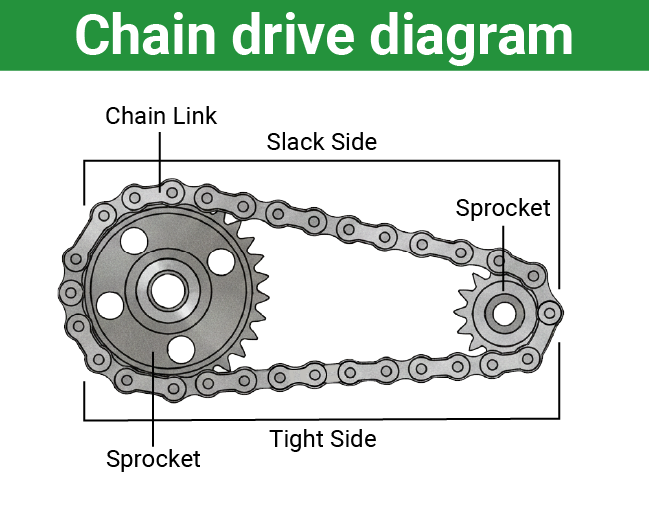
Chains, usually made of hardened or stainless steel, are incredibly strong and durable, making them ideal for harsh environments or high shock load applications. However, chains can be resource intensive, requiring lubrication, replacements, and frequent tensioning, which increases their lifetime cost.
You'll often find chain drives where strength and durability outweigh accuracy. Low speed, high torque applications, like compactors, are perfect for chains, as are heavy-duty elevators, which experience high shock loads that chains can handle. They're also popular in agricultural settings because of their ability to handle dirt and other exposures.
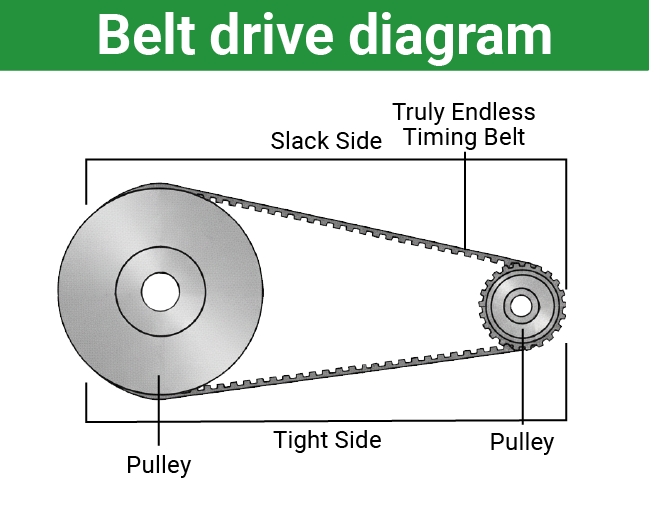
Timing belts, on the other hand, are toothed belts that mesh with pulleys to transfer motion. The base of a timing belt is usually constructed of something like polyurethane, a strong and durable polymer that can withstand wear over time. Within the timing belt are tension members that give the belt its strength.
The construction of timing belts prevents them from experiencing the elongation that chains do, making them far more precise. They’re also much easier to maintain and require fewer replacements, so they tend to cost less over their lifetime than chains. Plus, timing belts are much quieter, cleaner, and more efficient.
The table below outlines some of the key differences between timing belts and chain drives:
Timing belts eliminate many of the servicing and safety challenges that come with chain drives. They don’t require lubrication, removing the risk of grease contamination and spills on products, equipment, and the production floor, which creates a clean, hazard-free environment. Their lightweight design also has fewer pinch points, making them easier and safer to replace.
Reduced upkeep is becoming more critical as more industrial facilities cite labor shortages. According to a 2024 study from Deloitte and the National Manufacturing Institute, the domestic manufacturing sector is having difficulties securing skilled laborers, including maintenance professionals. Solutions that increase efficiency and lower service requirements, like switching to timing belts, are essential.
There's also no metal-on-metal contact with timing belts and pulleys, drastically reducing drive noise and vibration. This puts less stress on components and helps facilities meet noise exposure requirements and increase worker comfortability, which can directly improve safety conditions.
In many cases, the components used in chain drives have a lower upfront cost than those in belt drives. But upfront costs don’t give you the whole picture. When you consider the long-term costs of servicing, replacements, and downtime associated with chain drives, they often cost more over their lifetime than timing belt drives.
While regularly inspecting polyurethane timing belts is good practice to monitor for signs of timing belt failure, they generally require less frequent replacements, readjustments, and lubrication, meaning you spend less on maintenance related labor and materials. Less upkeep means less downtime, providing you with an automatic return on your investment in timing belts.
The combination of polyurethane and high-strength tension members allows timing belts to resist elongation over time, minimizing backlash. Unlike chains, which gradually stretch and require frequent adjustments, the construction of polyurethane timing belts provides accurate motion control even as the belt ages.
The smooth, continuous engagement between the belt’s teeth and pulley grooves also reduces vibration and provides stable movement even at high speeds. These traits make timing belts ideal for applications where exact timing and repeatability are needed, like indexing conveyors, pick-and-place robots, or printing.
Timing belt drives are more efficient than chain drives, largely because of their weight. Chains are heavy, which puts more wear on the drive components, increases friction, and noticeably increases the drive’s energy demands.
Commercial and industrial electricity rates have soared by more than 27% and 30% respectively over the last five years, meaning a switch to timing belts could result in substantial energy cost savings.
Timing belts offer more flexibility when it comes to customizations for drive systems. While you can choose between different metals, finishes, and attachments for chains, timing belts have far more customization options, especially through BRECOflex. When it comes to BRECOflex polyurethane belts, you can pick and choose several options, like:
In general, timing belts are ideal for applications where repeatability, cleanliness, low maintenance, and quiet operation are critical. Here are a few examples of when a timing belt might be better than a chain drive:
These are just some of the scenarios in which timing belts can be used instead of chains. Ultimately, timing belts are incredibly versatile. You can see a 12-millimeter-wide (0.47 inch) timing belt in the joint of a robot arm, or a 150 mm wide (5.9 inch) belt conveying cartons through a manufacturing plant. It all depends on the demands of the specific application. Use our industry-specific resources to learn more about timing belts in different industries.
While timing belts offer several advantages, certain applications still require the strength and durability of chain drives. Their steel construction gives them exceptional resistance to abrasion, impact and harsh environmental conditions, and they can often handle heavier loads and better tolerate shock.
These characteristics make chains popular for outdoor or heavy-duty applications, like agricultural equipment or construction machinery. There are timing belts available to handle high loads, like the BRECOflex move-series, but there are rare cases that demand the level of tensile strength and resistance that chains provide.
Contact the BRECOflex engineering support team to find out if your application can be upgraded to a timing belt.
You can’t apply a one-size-fits-all approach when deciding to use timing belts and chains. The right choice depends heavily on the specific conditions and needs of your operation. Here are a few key things to consider when trying to determine if a chain drive or a timing belt system is right for you:
There are many factors that go into selecting the right drive system for your operation and machinery. In general, timing belts are best for applications that require repeatable, smooth motion with low-noise and low-maintenance operation. Chains are ideal for heavy duty applications that are exposed to extreme conditions.
But, knowing exactly which is best for your needs can be difficult. Luckily, BRECOflex can help. Our applications engineering support team can provide personalized assistance to help you figure out the timing belts that can best meet your demands. Best of all, our engineering support comes at no cost to you.
When it comes to polyurethane timing belts, BRECOflex has been the industry leader for over three decades. Contact our support team today to increase your precision and efficiency.