Extruded Timing Belt Backings: Types, Benefits, and Applications
April 29, 2026
Extruded Timing Belt Backings: Types, Benefits, and Applications
Adding a backing cover to a timing belt can help improve performance and lifespan by meeting specific application needs, and it can even protect products being conveyed. Some backing materials are extruded directly onto the back of the belt, resulting in a stronger bond and more even surface.
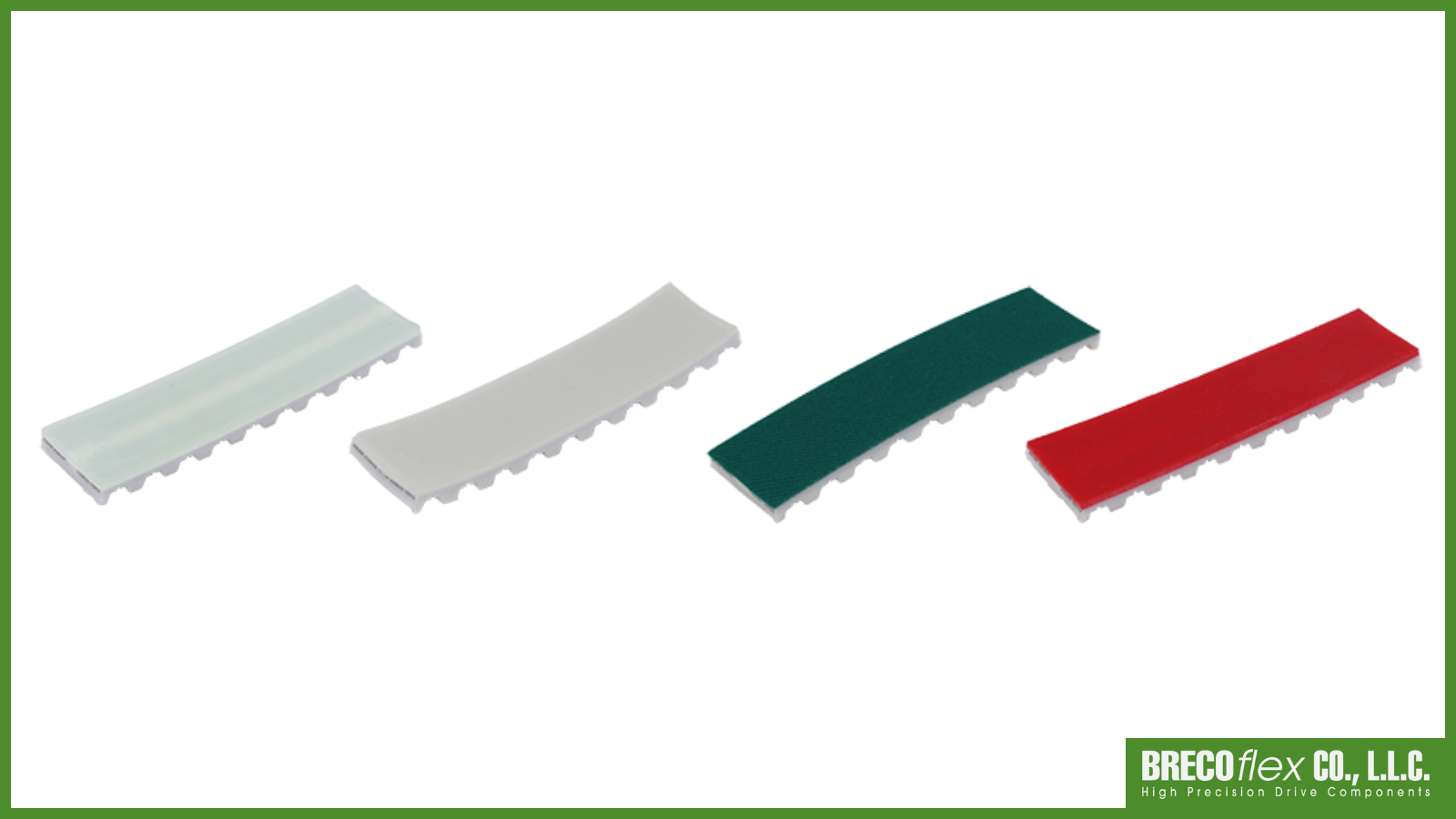
BRECOflex offers several materials as extruded backings, including:
T-Cover: An 85 Shore A polyurethane material that improves wear resistance
DR (or an extra thick belt): An extra thick layer of the same polyurethane material as the base belt
PAR: A nylon fabric backing to reduce friction
PU 60: A 60 Shore A polyurethane material available in up to 6 mm thickness for delicate, cushioned product handling
TPEX: An FDA-compliant thermoplastic elastomer material with good water resistance, available exclusively on TPEXclassic belts
While extruded backings can have significant benefits, several factors must be considered, including what material is appropriate and if an extruded backing is even the right choice.
Extruded vs. bonded backing application
Timing belt backings are layers of material that are added to the back of a belt to improve performance under specific application conditions. Backings are typically applied to timing belts in one of two ways:
Extrusion, when the backing material is added directly onto the belt as one continuous layer during manufacturing, creating a uniform surface and a strong attachment to the base belt.
Bonding, in which a backing material is applied using a joint and an adhesive. BRECOflex refers to these as “applied backings”.
Extruded backings have a more uniform surface and a stronger attachment to the base belt than applied covers. However, the adhesive bonding process makes it possible to use a wide range of materials that can’t be extruded as back covers, like rubber or foam.
Benefits of extruded timing belt backings
Extruded backings come with several advantages, including:
Superior bond strength: The extrusion process provides a stronger bond between the backing material and the timing belt than an applied application, reducing the risk of delamination.
Uniform surface: Extruding material provides a controlled thickness across the whole belt, leading to improved positioning and better tracking.
Fewer failure points: Because extruded backings are formed as part of the belt, there is no adhesive layer, helping minimize belt failure. Applied backings are durable, but the glue line is a potential separation point, especially in more demanding applications affected by high loads, washdown conditions, or chemicals.
No glue: While the adhesive used with applied backings is durable, it can present compliance challenges in FDA-regulated environments if the glue itself isn’t food safe.
Faster production timelines: The extrusion process eliminates the time needed for an applied backing to adhere to the belt and for the glue to dry.
Extruded backings aren’t the right choice for every application. While extrusion can improve bond strength and performance, some systems can benefit more from a bonded backing. The adhesive bonding process allows for far more materials to be used as belt covers, all of which can have specifications that better withstand certain environments and performance factors than extruded options.
Types of extruded timing belt covers
BRECOflex offers several types of extruded timing belt backings to meet the needs of various applications.
T-Cover
T-Cover is an extruded polyurethane backing that provides grip and good wear resistance for reliable performance for general conveying applications. Its high coefficient of friction and excellent machinability makes it ideal for incline conveyors, package handling, or indexing systems.
Specification
Value
Material
Polyurethane
Color
Transparent
Thickness
2 mm (1.5 mm for T5)
Hardness
85 Shore A
Temperature Resistance
-20°C to +80°C (-4°F to 176°F)
Coefficient of Friction (Aluminum)
0.8
Abrasion Resistance (ISO 4649, Tempered)
15 mm³
Chemical Resistance
Simple oils & grease, petrol, ozone
Minimum Pulley Diameter
60 mm
FDA Compliant?
No
Bottom line: T-Cover is best suited for conveying applications where high grip and product stability is priority.
DR
DR is an extra thick belt construction rather than a standard extruded backing layer, meaning that the “backing” is made of the same polyurethane material as the base belt. This additional layer can be applied like other extruded backings by being extruded onto the back of an existing belt, or it can be extruded at the same time as the belt, creating a fully homogenous belt with no bonded layers.
The biggest advantage of DR comes from its increased thickness. Thicker belts have higher wear resistance, allowing them to better withstand continuous surface contact than standard belts. They’re also better equipped for conveying heavier items by minimizing the effect of compression, which can be especially useful in conveying metal parts and industrial components.
Specification
Value
Material
Polyurethane (TPU-ST1)
Color
White
Thickness
Varies with belt pitch
Hardness
92 Shore A
Temperature Resistance
0°C to +80°C (32°F to 176°F)
Coefficient of Friction (Aluminum)
0.2
Abrasion Resistance (ISO 4649, Tempered)
30 mm³
Chemical Resistance
Simple oils & greases, gasoline, ozone
Minimum Pulley Diameter
Varies with thickness and belt pitch
FDA Compliant?
No
Bottom line: DR belts with extra thick backs are excellent for high abrasion and wear environments and applications that require heavy load conveying.
DR thickness. The general rule is that the extra thickness added to the top of the belt is equal to the thickness of the tooth, meaning it varies by the
belt pitch.For example, an extra thick belt with a 2.5 mm tooth will have a 2.5 mm DR layer.
to find the information you need.
PU 60
PU 60 is another extruded polyurethane backing durable enough for general conveying, but its softer surface allows it to handle products more delicately than other PU cover options. Available in thicknesses from 2 to 6 mm, extruded PU 60 backings can act as a cushioning to protect products, and is particularly beneficial for handling irregularly shaped parts, glass products, finished goods, or accumulation lines.
Specification
Value
Material
Polyurethane
Color
Transparent
Thickness
2, 3, 4, 5, 6 mm
Hardness
60 Shore A
Temperature Resistance
-20°C to +80°C (-4°F to 176°F)
Coefficient of Friction (Aluminum)
1.2
Abrasion Resistance (ISO 4649, Tempered)
26 mm³
Chemical Resistance
Simple oils & greases, gasoline, ozone
Minimum Pulley Diameter
80–180 mm
FDA Compliant?
No
Bottom line: PU 60 has a soft surface and multiple thickness options for delicate product handling, while still having a high coefficient of friction for consistent grip.
PAR
PAR is a unique extruded backing, made of a polyamide fabric that is used to minimize friction. The wear-resistant fabric allows products to easily slide from the belt without adding much to the total thickness of the belt. Because of this, belts with PAR backings remain flexible and can be used with smaller minimum pulley diameters compared to other covered belts.
Specification
Value
Backing
PAR
Material
Polyamide
Thickness
0.5 mm, 0.8 mm
Temperature Resistance
-20°C to +50°C (-4°F to 122°F)
Coefficient of Friction
0.3
Chemical Resistance
Simple oils and fats
Compliance
No FDA
Minimum Pulley Diameter
0.5 mm (15 mm), 0.8 mm (25 mm)
FDA Compliant?
No
PAR is popular for low friction conveying but is also common in systems that require reduced sliding contact within machines where belts may run against structural components or minimize static in systems with sensitive electronics or sensors.
Bottom line: PAR is a low-friction nylon belt backing that allows products to easily be released, ideal for accumulator conveyor applications.
PAZ tooth side coating. The same polyamide fabric can be extruded onto the tooth side of a timing belt to reduce friction and noise within a belt drive. When applied to the belt teeth, it is known as PAZ.
TPEX
TPEX is a soft thermoplastic elastomer material with a moderate to high coefficient of friction. It’s an excellent extruded backing for food and beverage applications thanks to its FDA compliance and high resistance to water and water-based solvents that are common in those environments.
Specification
Value
Material
TPE
Color
Red
Thickness
2 mm
Hardness
41 Shore A
Temperature Resistance
-40°C to +80°C (-40°F to 176°F)
Coefficient of Friction (Aluminum)
0.8
Abrasion Resistance (ISO 4649, Tempered)
152 mm³
Chemical Resistance
High resistance to water
Minimum Pulley Diameter
60 mm
FDA Compliant?
Yes
Bottom line: TPEX is an FDA-compliant extruded backing with good resistance to water, a high coefficient of friction, and a soft surface.
TPEXclassic Timing Belts The TPEX extruded backing is a key component of BRECOflex’s specialty
TPEXclassic belts.
The backing is extruded onto a timing belt designed specifically for low to moderate load conveying, lowering costs and lead times.
Extruded timing belt backings compared
Extruded backings have the same general manufacturing advantage of being a continuous layer added without adhesives. But the exact characteristic of the specific materials makes each one suitable for very different applications.
High friction applications: PU60 is the extruded backing with the highest coefficient of friction, making it a good choice for systems that require significant grip.
Delicate product handling: A low durometer, thick backing layer like PU60 can be ideal for transporting finished products, glass items, or irregularly shaped components.
Heavy-duty conveying and wear resistance: DR and T-Cover belts are the beneficial when it comes to high-load, abrasive systems. The strong bond extrusion provides helps prevent delamination under load, and the added thickness provides higher wear resistance to extend belt life.
Low friction applications: PAR extruded nylon fabric backing provides a low friction surface that allows products to slide across the belt with minimal resistance, useful in accumulation conveyors and select packaging and distribution equipment.
When to choose an extruded belt backing
Extruded backings are commonly used in applications such as high wear conveying systems, systems with frequent exposure to water, or precise positioning requirements. In general, deciding whether to use an extruded belt backing is like choosing any drive component: consider the environmental conditions, performance needs, and drive geometry.
Choosing the right backing can make a significant difference in how well a belt system operates. The team at BRECOflex can help you evaluate requirements such as load, friction, environment, and system layout to determine the most effective belt and backing configuration. Contact us today for free customer service and engineering support or learn more about all of our customization options.
Contact Us
If you have any questions or comments please Contact Us and we will be happy to help you.