
Choosing the right pulley is critical to designing efficient and durable drives. It goes beyond selecting the diameter and tooth profile compatible with a timing belt; pulley material has a significant impact on drive performance and, more importantly, lifespan.
Aluminum is the most common material used for pulleys, but some applications need a material that can better withstand harsh exposures, meet certification requirements, and handle specific loads.
This guide breaks down four pulley material options, their characteristics, and the types of applications they are best suited for.
Much like timing belt material options, BRECOflex offers several pulley materials, each one suited for a different set of application requirements.

Application Examples: Moderate power transmission, pick-and-place robotics, conveyor systems, packaging machinery, linear positioning systems
For many applications, aluminum pulleys bring the best value and great performance, which is why it's the most common material for industrial pulleys and the standard pulley material at BRECOflex.
While it’s not the cheapest pulley material available, aluminum is far more durable and provides better performance than pulleys made of low-cost materials, like plastic. It manages to have moderate chemical, corrosion, and abrasion resistance, while remaining lightweight.
Its weight is one of its biggest benefits. Because it weighs less than materials like steel, it reduces rotational inertia, allowing for quicker motion responsiveness. It also takes less energy for the pulleys to start, stop, or change direction and puts less stress on the system’s motors and bearings, which can reduce overall system costs.
However, aluminum pulleys aren’t suited for heavy loads, abrasive conditions, or extreme heat that can be found in rugged applications like mining, milling, or very large industrial drives.

Application Examples: Food processing conveyors, pharmaceutical equipment, bottling and packaging lines, clean room machinery, outdoor equipment
Stainless steel is another popular material for timing pulleys because of their corrosion resistant, hygienic surface. The high durability of stainless steels allows the pulleys to withstand exposure to cleaning agents, salts, and water, and they resist bacterial growth. These properties make stainless steel pulleys excellent for FDA regulated environments, wash-down systems, or cleanroom applications.
That durability does come with a few potential trade-offs, mostly in regard to weight and cost. Stainless steel timing pulleys are heavier than aluminum, and while that does give them the ability to handle higher loads and more torque, it also makes them less responsive, with slower acceleration and deceleration rates.
Stainless steel materials are also more expensive and difficult to manufacturer, increasing the overall cost. However, its durability and high corrosion resistance can lead to a longer service life for stainless steel timing pulleys.
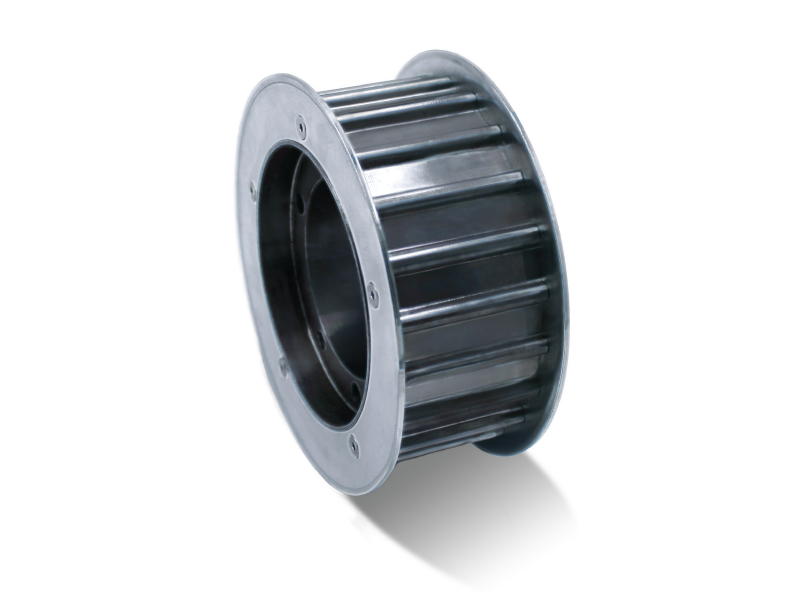
Application Examples: Heavy machinery, mining equipment and systems, bulk material handling, industrial conveyors, chain conversions
Steel pulleys are used in heavy-duty industries, like the mining or brick industries. Because of steel’s extreme durability, it can handle high levels of torque, belt tension, and shock loading, all while holding up against harsh abrasion and environmental conditions. Even under heavy loads, steel timing pulleys can resist deformation and impact damage, which is why you’ll often find them in applications that handle heavy weights.
Because steel is so hard and heavy, it can make it more difficult to manufacture and machine than something like aluminum. The weight of steel pulleys also increases rotational inertia and requires a high start-up load to get things moving.
While steel is quite resistant to abrasive materials, it is susceptible to corrosion, resulting in rust when exposed to moisture or used in high-humidity environments. Rust can cause inefficiencies, accelerate belt wear, increase friction, and even cause tracking or vibration issues. It can also be a cleanliness issue, potentially contaminating products.

Application Examples: Light-duty conveyors, medical devices, printers, laboratory equipment, electronic assembly machinery
Delrin®, a durable engineering plastic, can be used to make lightweight, FDA-compliant pulleys, ideal for systems that require low noise, reduced friction, and high corrosion resistance. Because Delrin® pulleys are non-conductive, they can be essential when designing systems that handle certain sensitive electronics.
Acetal homopolymer plastic has great dimensional stability, but still isn't as strong or durable as metals, meaning Delrin® pulleys can’t handle the same torque, tension, or shock loads that aluminum or steel pulleys can. They also have more environmental limitations, with lower abrasion resistance and narrower temperature tolerances.
Overall, Delrin® pulleys are used in lightweight systems that benefit from non-metallic properties or require FDA-compliance, but are generally avoided for heavy-duty applications.
Coatings and finishes can be applied to timing pulleys to better meet application needs, like increasing chemical, corrosion, and abrasion resistance. BRECOflex offers six pulley coating options, with additional finishes available upon request:
The right pulley material is tied directly to the application.
Getting the correct pulley material down is just one part of designing an optimized pulley for an application. BRECOflex offers a range of flange options, keyways, hubs, and several hole types and configurations to customize pulleys to meet the system’s exact requirements. Our state-of-the-art manufacturing facility in New Jersey allows us to turn custom pulley designs into a reality, with some of the shortest lead times in the industry.
If you’re not sure where to start when it comes to selecting a pulley, BRECOflex offers free, personalized design support from our Application Engineering team. Ready to get the pulley you need?


