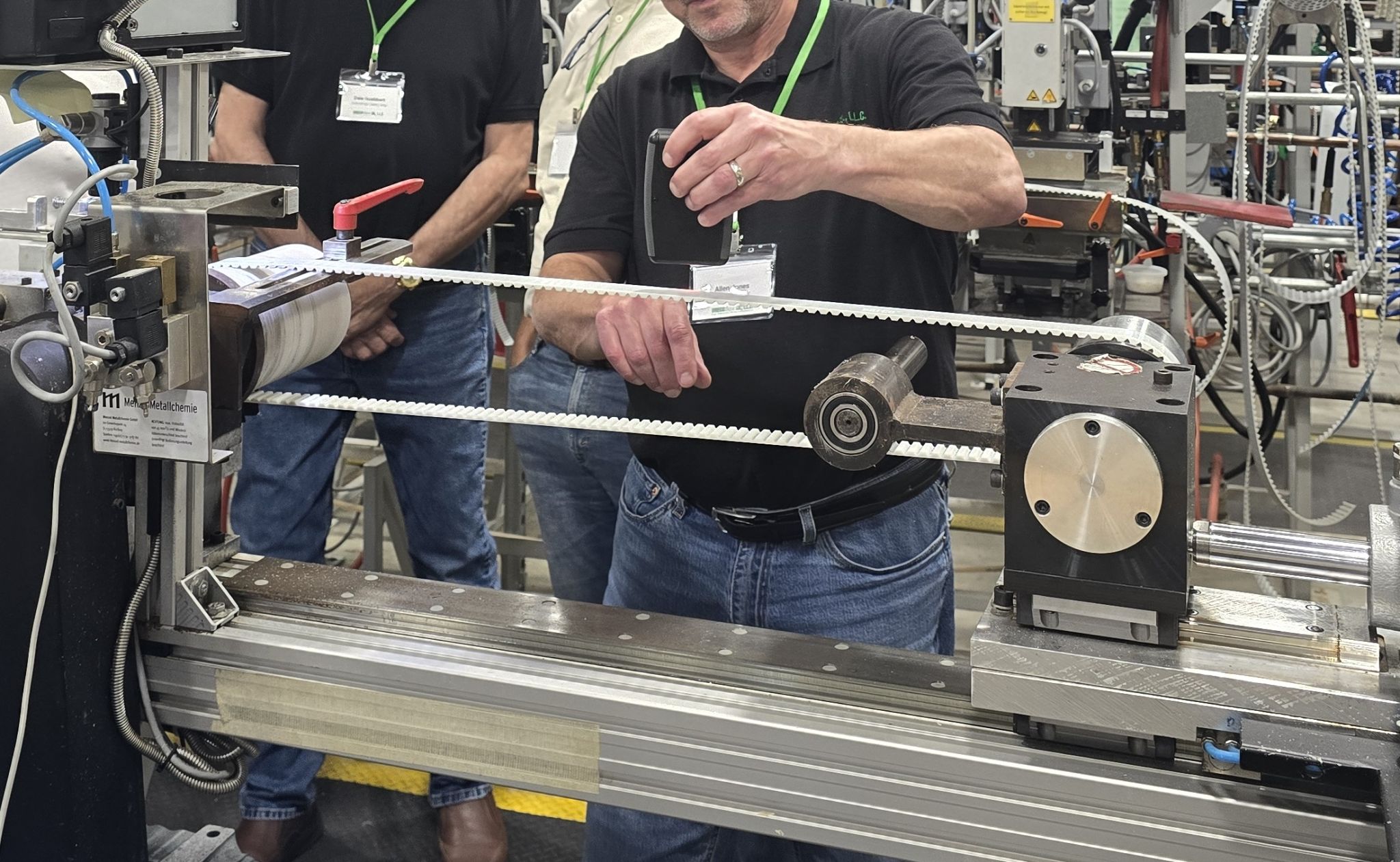
Reducing pulley backlash and increasing positioning accuracy requires a two-part approach. Timing belts and pulleys working together will help you achieve reduced or zero backlash with optimal belt stiffness and accuracy.
Key Takeaways:
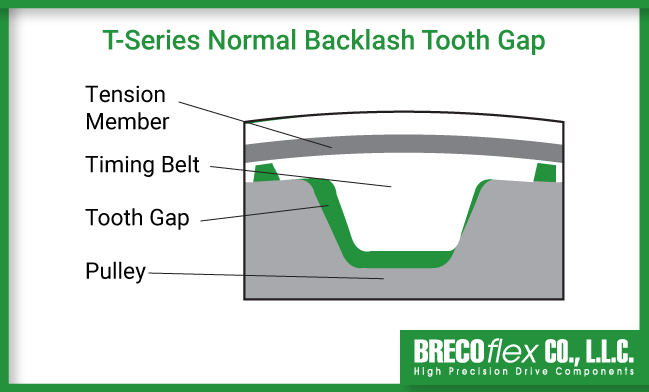
Backlash is the small, but measurable, amount of movement that occurs as timing belt teeth move across the slight gap between the belt tooth and the pulley groove. That gap, sometimes called a tooth gap or clearance, is normal, and allows the belt to smoothly engage with the pulley, compensate for manufacturing tolerances and natural deformations under load, and make installation easier.
Some applications, like high-speed conveying, can tolerate backlash in their system, while high-precision applications require backlash to be minimized as much as possible. The acceptable level of backlash ultimately depends on how much positioning accuracy an application demands.
Pulley backlash introduces a level of play into a drive system when the belt stops or changes direction. That play introduces a slight delay in motion between the driving and driven components and can lead to belt vibration or oscillation. As mentioned above, many applications can operate with the standard level of pulley backlash and see no impacts on the system’s performance.
High-precision applications, on the other hand, require reduced or zero backlash pulleys to achieve accurate, repeatable motion. For example, in a servo-driven linear actuator used in CNC machining, even a small tooth gap can create a slight delay in torque transfer or create low levels of vibration, ultimately impacting accuracy. It may only be fractions of a millimeter, but it can result in misaligned cuts or reduced repeatability over time.
When designing a timing belt drive, it’s important to consider the priorities of the application, the intended performance, and how backlash can impact it.
Backlash can be reduced in a reversing belt drive in a few ways, including using reduced or zero backlash pulleys, proper belt tensioning, and regular maintenance and inspections.
Designing a drive system with reduced or zero backlash pulleys can mitigate, or even eliminate, the effects of backlash. The tooth geometry of these custom pulleys is optimized for tighter engagement with timing belt teeth, reducing the size of the tooth gap, and minimizing backlash motion for a more precise system.
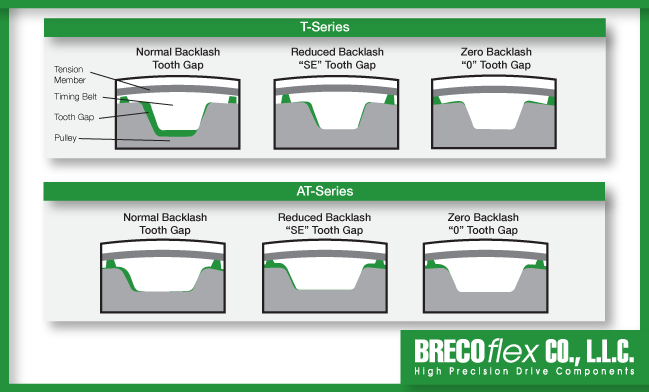
BRECOflex offers three pulley tooth design options, each of which is manufactured to engage with belt teeth in a specific way:
Reduced Backlash and Zero Backlash options are available for T, AT, and ATN series pulleys, including self-tracking versions.
The image below shows the difference in tooth gap size between the three pulley designs:
By pairing Zero Backlash pulleys with move-series® timing belts, which are 75% stiffer than standard BRECOflex belts, backlash is minimized, elongation is reduced, and stable pretension can be better maintained under load, all of which support highly precise motion.
Backlash can be amplified by improper belt tension, usually when a belt is too loose. When under-tensioned, the teeth may hover slightly above the pulley grooves, effectively increasing the tooth gap. This creates more space that a timing belt tooth must travel over before it fully contacting with the other side of the pulley groove.
Maintaining proper tension can reduce lost motion in a drive and improves overall precision. Using tools like the SM5 Tension Meter or incorporating tensioners or tensioning clamps into the drive design (when appropriate) can help keep operating tension consistent without overtightening, which can lead to additional timing belt problems. For more information, read our complete guide to timing belt tension.
Even if a drive is designed with reduced backlash components and is properly tensioned, its performance can change as it operates. Wear and other system changes gradually influence backlash, which is why maintaining timing belt inspection and maintenance schedules is crucial.
Pulley wear, tooth wear, tension fatigue, and misalignment can all increase the effects of backlash over time. By regularly inspecting the system, these issues can be identified early, before they cause product loss, production delays, or timing belt failures.
While reduced and zero backlash pulleys do provide substantial benefits, especially in high-precision systems, there are a few drawbacks to consider:
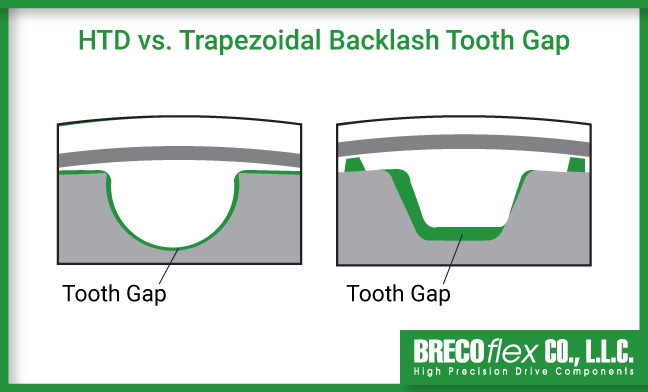
HTD timing belts experience higher levels of backlash than timing belts with trapezoidal teeth. It all comes down to the shape of the belt tooth and how it fits into the pulley grooves:
The impact of tooth shape on backlash is one of the reasons why trapezoidal tooth profiles are more popular for high-precision applications than curvilinear ones.
Backlash is a normal and necessary part of timing belt drives. But in precision applications, it must be accounted for in the design. Understanding how tooth geometry, belt stiffness, and tensioning influence lost motion is the first step in designing drives that deliver accurate and repeatable performance.
For high-precision systems, even small amounts of lost motion can compound over time. Designing with reduced or zero backlash pulleys, high-stiffness belts, and preparing proper tension and inspection guidelines will help the drive perform as intended.
BRECOflex offers the components and technical expertise to help build a drive system that minimizes backlash. Not sure where to start? Contact BRECOflex for free, personalized design support from our Application Engineers.